

When schools decide to reduce phone use during the day, the real challenge is rarely policy language. It is execution. Rules can sound firm on paper and still collapse in hallways, classrooms, and lunch periods if they depend on constant confiscation, teacher-by-teacher enforcement, or daily arguments. The schools that are truly thriving with Safe Pouch® are not simply banning devices more loudly. They are creating a calmer, more consistent environment where students know what is expected, staff are not pulled into endless policing, and learning regains its proper place at the center of the day.
Why successful schools move beyond simple phone bans
Many schools begin with a familiar goal: fewer distractions, less social friction, and more attention in class. What often undermines that goal is the method chosen to get there. Traditional approaches can place too much burden on teachers, front-office staff, or administrators who already manage a full workload. If every lesson begins with device collection, or if every violation triggers a confrontation, the policy can become one more source of disruption rather than a solution.
The schools seeing the strongest outcomes tend to understand one thing early: students respond better to systems than to constant warnings. A decentralized model helps because it keeps the policy visible, routine, and fair across the school day. Safe Pouch® is designed around that principle. Instead of turning enforcement into a series of personal disputes, it builds a structure in which students keep possession of their own phones while access is restricted until the appropriate time.
That distinction matters. Students are often more willing to comply when they know their property remains with them, and staff benefit because they are no longer expected to manage piles of devices or negotiate exceptions every period. The result is a policy that feels practical rather than punitive.
What success looks like in schools using Safe Pouch
Success stories in this area are usually quieter than people expect. They are not dramatic transformations staged for publicity. They are the everyday signs of a healthier school rhythm: faster starts to lessons, fewer interruptions, more direct eye contact, and less emotional charge around the issue of phones. In schools where the system is introduced clearly and applied consistently, the gains show up in culture as much as in discipline.
Staff often notice that they spend less time acting as device monitors and more time teaching. Students begin to understand that the expectation is universal rather than selective. Families, even when initially cautious, may come to appreciate the predictability of a policy that reduces in-class phone use without requiring students to surrender personal items to a desk, bin, or office.
- Classroom openings become smoother. Teachers can begin instruction without first settling a round of phone reminders.
- Hallway transitions feel less chaotic. Students are not constantly checking screens between periods.
- Peer tension may ease. Reduced access can mean fewer impulsive recordings, posts, or message-driven conflicts during school hours.
- Enforcement becomes more consistent. The policy is anchored in a daily routine instead of depending on individual staff tolerance.
For schools comparing practical options, a Lockable phone pouch gives staff a way to enforce a phone-free day without turning every classroom into a collection point.
Why the decentralized model works better in practice
The phrase “decentralized phone ban” can sound technical, but in practice it solves a very human problem. Schools need a method that respects operations. Teachers need to teach. Administrators need a policy that can be applied school-wide. Students need clarity. A system works when it reduces points of friction rather than multiplying them.
Safe Pouch® fits that need because it does not require every adult to reinvent enforcement throughout the day. The pouch becomes part of the school’s operational flow. Once expectations are established, staff are not carrying the full burden of monitoring physical possession. Students keep the device on them, but out of active use. That lowers the chances of loss, misplacement, and disputes over handling.
| Approach | What staff manage | Common friction points | Likely school experience |
|---|---|---|---|
| Teacher collection each class | Collecting, storing, returning phones repeatedly | Time loss, disputes, misplaced devices, uneven enforcement | High effort, inconsistent results |
| Honor-based classroom rule | Ongoing reminders and spot enforcement | Frequent challenges, selective compliance, staff fatigue | Easy to launch, hard to sustain |
| Decentralized pouch system | Clear school-wide routine and periodic compliance checks | Requires training and a strong rollout | More consistent, lower day-to-day friction |
This is where Win Elements’ business context feels relevant rather than promotional. Safe Pouch® is presented as a decentralized phone ban that works, and that framing aligns with what schools actually need: a realistic operating model, not just a slogan. The strongest implementations are not the ones with the harshest tone. They are the ones with the clearest routine.
How schools make the transition successfully
No school improves its phone culture simply by distributing pouches and hoping for the best. The successful stories tend to share a disciplined rollout. Leaders explain the “why,” set boundaries early, train staff on consistent language, and communicate with families before confusion has time to spread. That preparation makes the difference between a policy that feels orderly and one that feels reactive.
- Set a clear purpose. Schools do better when the policy is framed around focus, safety, and school culture rather than punishment alone.
- Standardize expectations. Students should hear the same message from administration, teachers, and support staff.
- Prepare for exceptions. Medical needs, accessibility requirements, and emergency procedures should be addressed in advance.
- Train staff in calm enforcement. Consistency matters more than intensity. A neutral script is often more effective than repeated confrontation.
- Review and refine. Early feedback helps schools tighten weak spots in arrival routines, unlocking procedures, and communication.
One of the most overlooked parts of implementation is tone. Students can resist a system they experience as arbitrary, but many will adapt to one that is steady, school-wide, and visibly fair. Families are also more likely to support the change when schools explain how the process works during the day, how devices remain with students, and how end-of-day access is managed.
The broader payoff: a healthier learning environment
The most compelling success stories are not really about pouches. They are about what becomes possible when phones stop dominating the day. Teachers can sustain momentum. Students can stay longer with difficult tasks. Conversations become more present. Schools regain a stronger sense of shared attention, which is increasingly valuable in environments where distraction has become normalized.
There is also an important cultural signal in a well-run phone policy. It tells students that school is a distinct space with its own priorities. That boundary can support maturity rather than suppress it. Students learn that there are times for connection and entertainment, and times for concentration, participation, and respect for the people in front of them.
Not every school will implement the same way, and no system removes every challenge overnight. But the schools thriving with Safe Pouch® show that the right structure can move the conversation away from daily device battles and toward a more stable educational environment. In that sense, the real success is not merely keeping phones out of use. It is restoring attention, predictability, and professional control to the school day.
Conclusion: A strong phone policy succeeds when it becomes routine rather than drama, and that is why a well-planned Lockable phone pouch system has become so valuable for many schools. Safe Pouch® offers a practical model because it balances enforcement with usability, helping schools reduce friction instead of adding more of it. The best success stories are the ones felt every period: fewer interruptions, clearer expectations, and classrooms that can finally focus on learning again.
************
Want to get more details?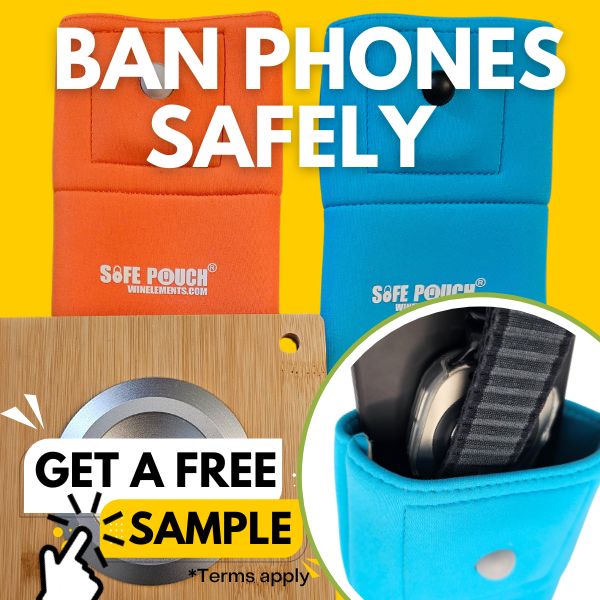
Win Elements | Lockable Phone Pouch
https://www.winelements.com/
Patented lockable phone pouches with multi-tiered lockers for phone locking pouches.
